
Does the project only work with government support?
No. Boolathana’s competitiveness rests on the quality of its renewable resource, not on incentives.
Parliament legislated Australia’s Hydrogen Production Tax Incentive in February 2025 and Boolathana would qualify, but GGE’s modelling shows the project’s economics remain viable at base pricing without it. The incentive accelerates payback and lifts returns; it does not enable viability. That distinction matters, because any policy remains subject to political and budgetary review.
Isn't this cyclone country?
Boolathana sits in north-west Western Australia, but well south of the Pilbara latitude where cyclone intensity concentrates. The Bureau of Meteorology’s long-term record for Carnarvon contains no public record of wind speeds exceeding 150 km/h, which supports IEC Class C turbine selection and standard insurance pricing.
Cyclone resilience remains a formal engineering and insurance diligence item, as it should be for any coastal infrastructure at this scale. The point is not that the site is immune – it is that its exposure is measurable rather than asserted.
Can a pastoral lease host a project like this?
Yes. The Western Australian government’s Diversification Lease framework is purpose-built to allow pastoral land to host new, compatible uses.
GGE holds a Section 91 licence under the Land Administration Act for the investigations the project requires, and exclusive access under a separate deed with the pastoral lessee running to December 2030, with a defined conversion to a Diversification Lease at the Final Investment Decision. The pastoralist release mechanism is agreed in principle. The residual variable is State Government timing on the lease award, not whether the pathway exists.
Is the ammonia plant too big to build?
The Stage 1 plant is large, and the design responds by building within demonstrated single-train precedent rather than around a single oversized unit, with later capacity becoming brownfield expansion within an operating facility. Co-locating generation and processing on one title removes the transmission and coordination complexity that burdens dispersed projects. The underlying process carries no invention risk: electrolysis feeding Haber-Bosch synthesis is proven at the highest technology-readiness level. The risk is execution at scale, which staged delivery and independent certification manage
The nearest comparable plant, NEOM, was approximately 80% constructed in early 2026.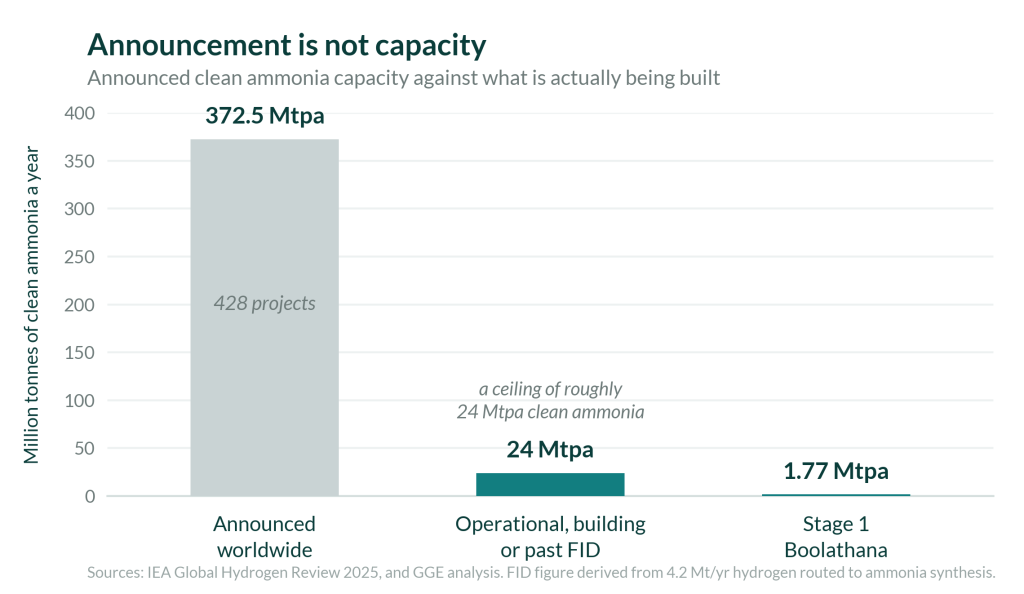
Why Chinese equipment?
Because at this scale there is no realistic alternative, and that is true of every utility-scale renewable project.
Chinese manufacturers hold dominant global supply share across wind turbines, solar, batteries and electrolysers, so competitive sourcing is a structural feature of the industry rather than a project-specific election. Boolathana’s off-grid configuration removes the grid-code compliance constraints that complicate such procurement elsewhere, and Australia imposes no anti-dumping tariffs on these categories. Commercial dialogue is established across all four categories.
Won't blue ammonia undercut it?
On cost, in some markets, for a while. Blue ammonia – made from gas with carbon capture – is 60 to 70 per cent of clean ammonia capacity at final investment decision or under construction, and it lands cheaper into Asia today.¹ GGE plans around that rather than disputing it.
But blue’s low-carbon claim rests on upstream methane leakage, the hardest variable to control and the least regulated. At realistic capture and leakage rates blue sits above the carbon-intensity ceilings that certification regimes are converging on; green sits an order of magnitude below them. Three frameworks have tightened in two years – the EU’s RED III ceiling, the Carbon Border Adjustment Mechanism from 2026, and Japan’s subsidy threshold, now on a published path toward the European standard. The result is that most practical clean ammonia demand by 2035 sits where green is favoured or blue is excluded – on GGE’s segmentation, somewhere between 55 and 80 per cent, depending on how maritime fuel is classified.²
Importantly, the 90–95 per cent carbon capture rates often associated with blue ammonia generally refer to capture from selected process streams rather than the total emissions of an operating ammonia plant. In conventional steam-methane-reforming facilities, current commercial experience indicates that only around 50–60 per cent of total plant CO₂ emissions is typically captured and permanently stored, with the balance largely arising from reformer combustion. Higher whole-plant capture rates may be achievable from next-generation autothermal reforming projects, but these remain largely design targets rather than established commercial operating performance.
The clearest signal comes from buyers. Major Japanese trading houses³ have begun securing exposure to future themselves. GGE’s modelling indicates that Boolathana’s delivered cost is competitive with blue ammonia before policy support is included.
¹ Sources: BloombergNEF, Ammonia Supply Outlook 2024; IEA; and GGE analysis. Capacity shares reflect projects at final investment decision or under construction as at March 2025.
² GGE analysis, classified against RED III, CBAM, India’s Green Hydrogen Standard, Japan’s Basic Hydrogen Strategy and FuelEU Maritime.
³ Source: Marubeni-Envision green ammonia offtake agreement, 2025.
Are sodium-ion batteries proven enough to rely on?
Sodium-ion storage is at an earlier stage of commercial deployment than lithium-ion, and Stage 1 specifies it. Two things make that a considered choice rather than a gamble: major manufacturers including CATL and BYD are scaling sodium-ion production now, and an off-grid application is less demanding than grid-scale service. Lithium-ion remains available as a fallback at higher cost, so the project does not depend on the technology maturing to a particular timetable.
Where do environmental approvals actually stand?
The first year of baseline flora and fauna work is complete on the downstream site, including a shorebird survey, and the second-year programme is under way. A Red Flag Multi-Criteria Assessment by Preston Consulting found no constraint that would, on a desktop basis, preclude the project, and coastal and marine baseline work is supported by completed metocean studies.
A wind build at this scale adjacent to 23 km of coastal frontage properly requires comprehensive avifauna, marine and cultural-heritage assessment. Referral under Commonwealth environmental law follows completion of the second-year baseline, with State approvals running concurrently.
The honest position: formal assessment may identify matters requiring extended timelines or design modification. That is a normal development-stage exposure, not a fatal constraint – and the site’s scale and uniform terrain give real flexibility to site infrastructure away from sensitive areas.
Is the offtake secured?
No, and GGE does not claim otherwise. No binding agreements are in place for Boolathana.
Worth knowing what that means in context. Across the whole sector, every secured green ammonia offtake in the public record is either government-underwritten or sold to a buyer holding equity in the project. NEOM’s thirty-year agreement is with Air Products, one of its three equal partners. The two contracts with disclosed prices — Egypt’s into the EU’s H2Global mechanism, and India’s SECI packages — are both policy-backed. Genuinely arm’s-length offtake, signed by an independent buyer at a disclosed price, is close to absent industry-wide. Breadth of market interest is not the same as bankable, priced demand, and GGE does not present it as such.
Industry-wide, signed offtake covered 1.7 Mtpa of hydrogen in 2024, down from 2.4 Mtpa in 2023, and only around 20% of those agreements were firm. (IEA Global Hydrogen Review 2025)
Engagement is under way with buyers across Europe, Japan and Korea, and offtake formation is a gating condition for the investment decision — the project proceeds only if delivered pricing is competitive. Australia’s own nitrogen market provides a nearer-term layer: mining explosives, urea import substitution, and AdBlue resilience, all against a shrinking domestic production base.