
DATA CENTRES
Firm renewable power for the data centres behind AI, cloud storage
and computing.
Always On
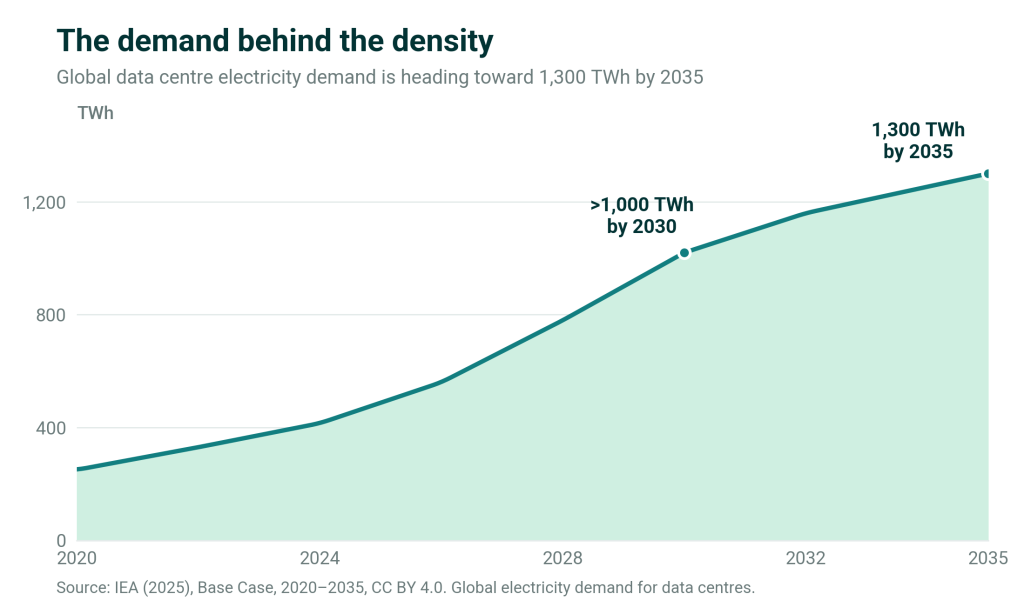
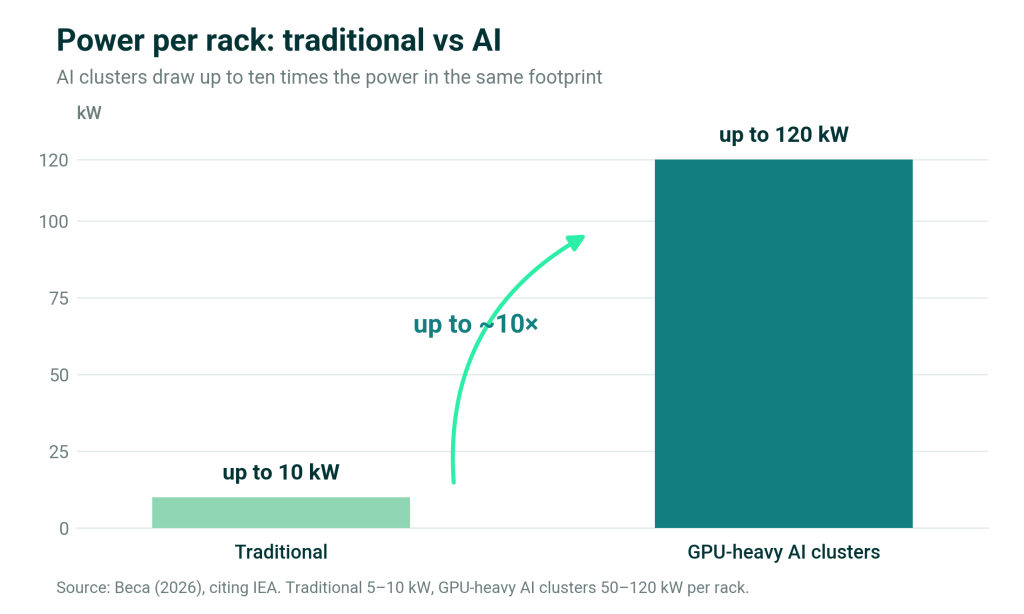
The data centres behind AI, cloud and computing need power that is constant, clean, and available every hour of the year. At the scale that matters, they arrive as campuses – clusters of buildings sharing one power supply, one water source and one security perimeter, drawing hundreds of megawatts between them. A grid connection delivers none of that reliably.
Grid power is contested. The same network serves households, hospitals and existing industry, the same connection queue governs everyone on it, and a gigawatt-scale load consuming capacity those users already depend on is the objection every large data centre now meets.
Nor does a renewable supply contract settle it. Most buyers match annually – buying a year of renewable generation against a year of consumption – and the shortfall falls overnight, because the generation being bought is heavily solar. Google has matched its global consumption with renewable energy every year since 2017. Measured hour by hour, it reached 66% in 2024, after the largest single-year clean energy purchase in its history¹ In Asia-Pacific the figure is 12%. Singapore has since set a standard requiring new data centres to draw at least half their power from approved green sources, low-carbon ammonia among them, and excluding renewable certificates bought without direct procurement.² It is a standard the grid there cannot presently supply. Through the night, the electricity arriving is whatever the grid is producing, and that is usually coal or gas derived.
Most renewable sites cannot do that without vast oversized battery storage. At Boolathana most of that work is already done by the resource itself.
Boolathana’s wind and solar oppose each other hour by hour. Wind strengthens through the afternoon and holds through the night, across exactly the hours solar falls to zero, so generation arrives close to flat before a single battery is added.
A data centre on Boolathana could draw whatever it needed, whenever it needed it. What the resource does not supply, the platform is designed to make for itself: green ammonia, produced on the same site, and used for power when it is called on. Across the seven-year hourly record, only 11.4% of the energy delivered would come from dispatchable firing.
Boolathana can deliver power that is carbon free in every hour of the year, generated and firmed on site behind the meter with no competition for energy from an interconnected grid and the use of no fossil fuels.
Firm By Nature
Firmness is normally something a project buys – banks of batteries, a backup generator, a grid connection to fall back on. At Boolathana the resource itself supplies most of it: wind and solar between them generate through almost every hour of the year. What remains is designed to be met from batteries and ammonia the platform makes itself, rather than from fuel brought in.
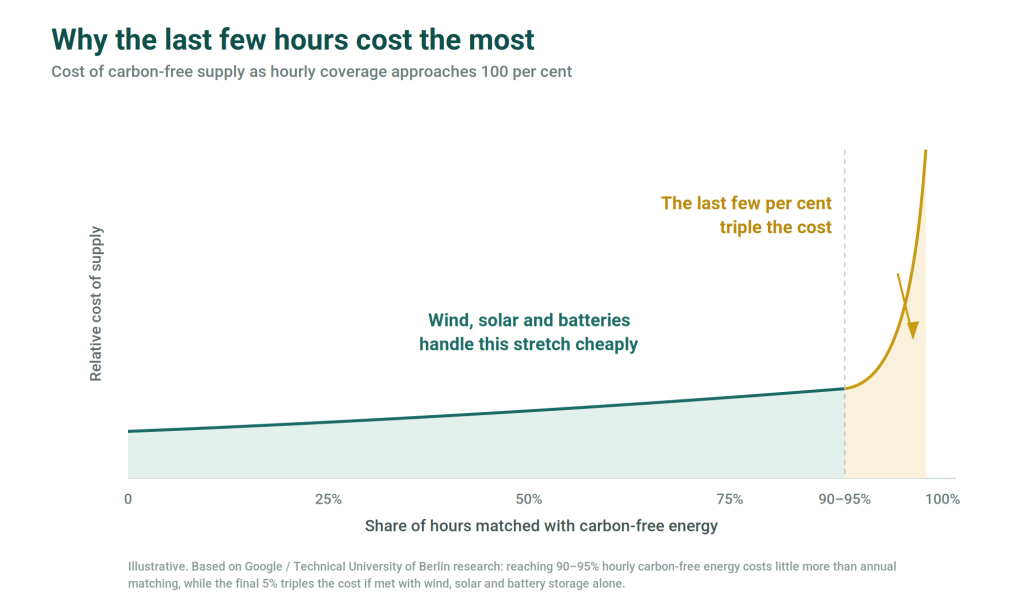
On Boolathana, that shortfall is small enough to solve on site.
For continuous renewable power generated entirely on site, the resulting overbuild is low – and it is the quality of the resource, not the scale of the equipment, that achieves it. Across the seven-year record, combined output fell to zero for a maximum of twelve hours – a single mid-winter overnight, set out in full on The Resource.
The remaining shortfall is met without diesel or gas – a claim almost no continuous renewable supply can make. The design and cost modelling behind it are available to qualified counterparties under NDA.
More Than One Business
One resource, more than one product. Each strengthens the case for the others.
A resource this firm can support more than one business.
The green ammonia plant and a data centre are the first two – independent of each other, sharing one platform, and each strengthening the commercial case for the other.
For the data centre, the result is supply that is carbon-free in every hour rather than on average, generated and firmed within the fence.
Connectivity and
Why Now?
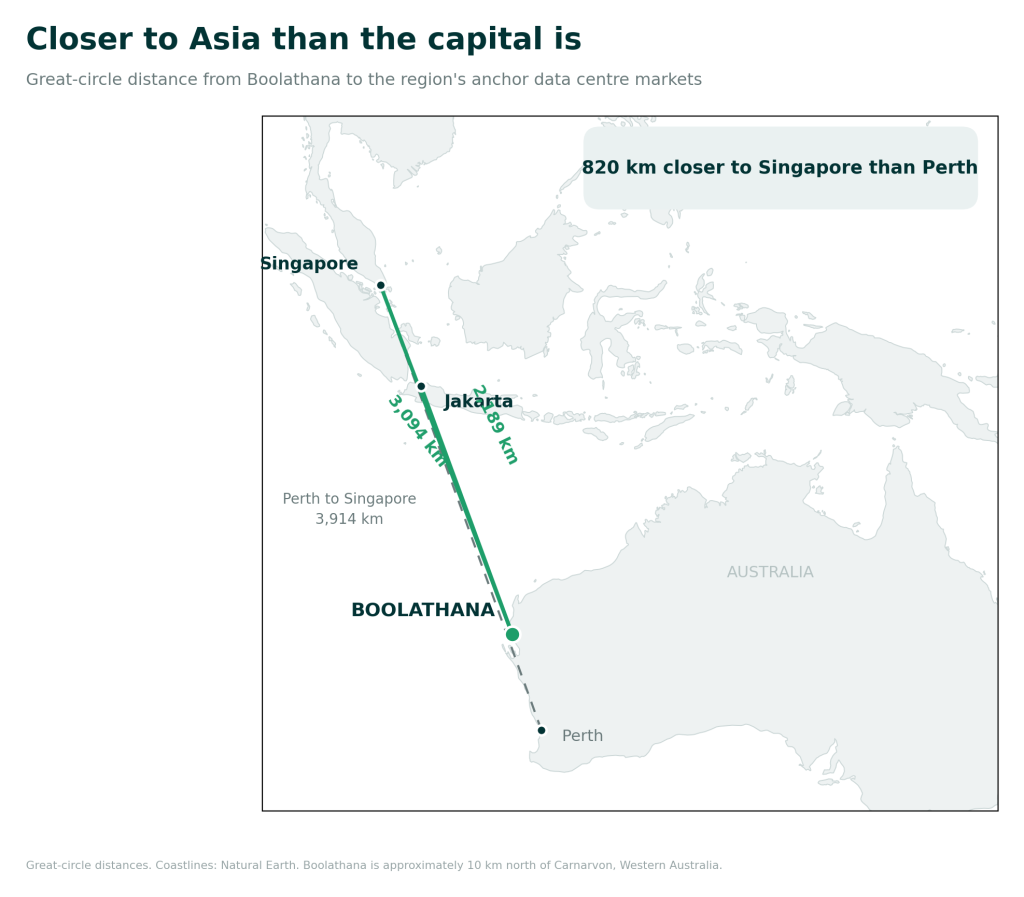
Boolathana sits more than 800 kilometres closer to Singapore than Perth does, and nearer still to Jakarta.
The power case at Boolathana improves with time. The connectivity case does not.
Everything a campus would need here is either in place or buildable: the resource, the land, the water, the firming fuel. Connectivity is the one element GGE cannot deliver alone. Operators are expanding subsea capacity between Australia and Asia through corridors that pass within reach of Boolathana’s coastline, and the economics of connecting to a cable strongly favour doing so while it is being laid rather than afterwards.
A second timetable runs alongside it. Australia’s Hydrogen Production Tax Incentive is available only to projects reaching an unqualified final investment decision before 1 July 2030, and Boolathana’s development programme is built to that date.
The site suits work that follows power rather than population: training large models, and processing bulk workloads where a few extra milliseconds are of no consequence. Work that must answer a user instantly belongs close to that user, and always will. Boolathana is not that site, and does not need to be.
Policy Fit
The rules are already written.
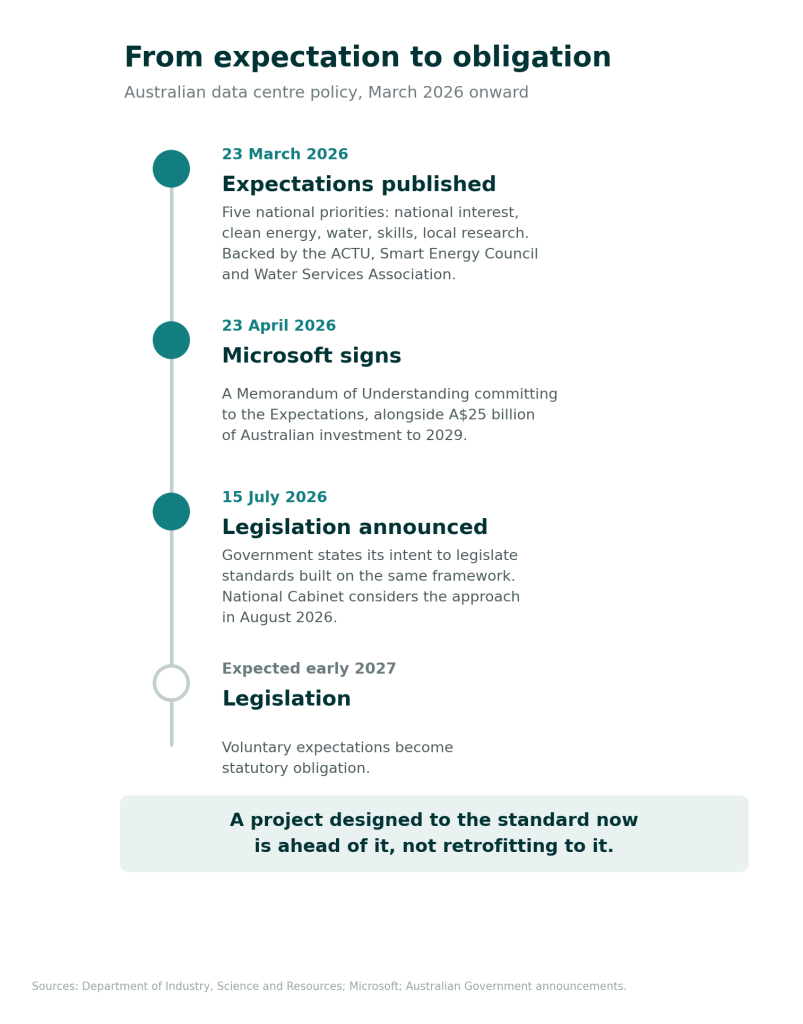
On 23 March 2026 the Australian Government published its Expectations of Data Centres and AI Infrastructure Developers, built around five national priorities: national interest, the clean energy transition, sustainable water use, skills and jobs, and local research capability.
Commonwealth regulatory assessment prioritises aligned proposals. In April, Microsoft signed a Memorandum of Understanding committing to those expectations alongside a A$25 billion Australian investment. In July the Government announced it intends to legislate standards built on the same framework.
Boolathana meets the energy and water expectations outright. Power that is carbon-free in every hour rather than on average, with no fossil reserve anywhere in the system. No competition for metropolitan potable water — the site desalinates its own from the Indian Ocean. No displacement of grid-served residential or industrial supply, because there is no grid behind the meter.
Singapore’s position is the same. Its Green Data Centre Roadmap recognises low-carbon ammonia as a green energy source, and its DC-CFA2 allocation requires new facilities to draw at least half their power from that list. The regulator of the region’s anchor market has already assessed the method Boolathana is built on.
Why Boolathana?

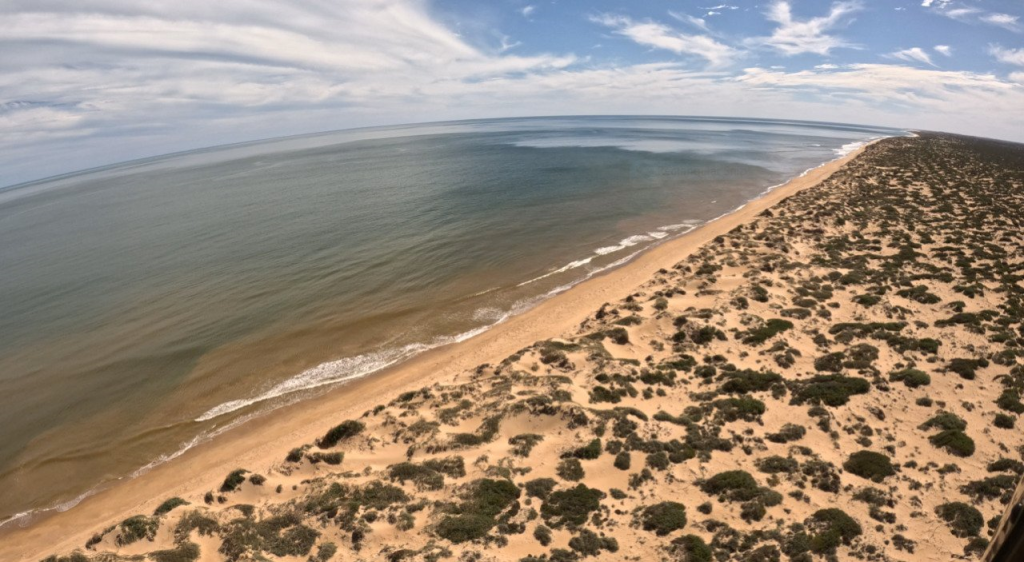
A measured resource, on ground nobody else can secure. Everything else follows from it.
Boolathana’s wind averages 8.89-9.02 metres per second at 150 metres, and it is strongest through the hours the sun is down. The resource has been measured, not assumed – independently characterised on site and The Resource sets it out in full.
The resource is not the whole advantage. It sits on one title with one counterparty, under a Section 91 licence with exclusive access held by separate deed, and no external network to depend on. Sites of this quality exist; sites of this quality that a counterparty can actually secure, on one title, do not.
The location answers two constraints a data centre cannot avoid: distance to market, and water. Boolathana sits close to the Asian markets where demand is growing fastest, markets that have run short of both power and water.
Water scales with the platform.
Groundwater on site can meet early requirements, and beyond that the coast provides seawater without practical limit, desalinated as needed. Water, the binding constraint across most of the region, is not a constraint here.
The platform is designed to scale in stages, with the land, seawater and ammonia in place to support growth well beyond a first campus.
Contact us
Have any questions?
For enquiries about Gascoyne Green Energy or
the GGE Boolathana Project please get in touch.