World-leading renewable resources and a tier-one platform for multi-gigawatt green energy export, independently validated - unsurpassed in Australia
The sun goes down.The resource doesn't.
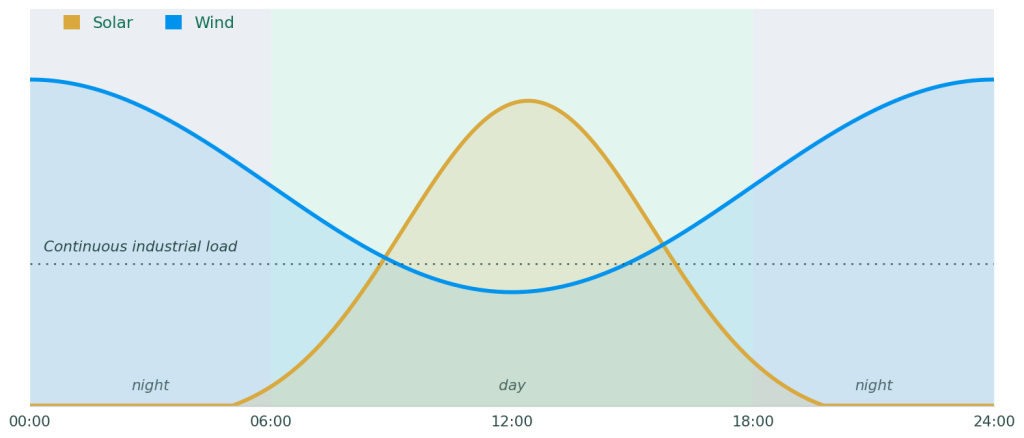
Sun by day, wind by night — two resources, one continuous supply.
8.89–9.02 M/S
–0.24
12 HOURS
NONE
Boolathana, located in the north-west Gascoyne region of Western Australia, pairs a top-decile onshore wind resource with elite solar irradiance across a flat, treeless coastal plain. The combination is found at only a handful of places on earth, and rarer still for the way the two resources behave together.
Their defining commercial feature is that they are naturally anti-correlated – a wind–solar coefficient of −0.24. Modest as a single number, it reflects something decisive in operation: as solar diminishes, wind strengthens into a consistent overnight maximum that fills the hours solar can’t. Strong sun by day, sustained wind by night: generation carries across the full 24-hour cycle.
This isn’t engineered firmness. The reason lies in the site’s coastal geography: the land and the ocean heat and cool at different rates, pulling wind inland through the night. It is a physical characteristic unique to the site, not something built onto it.
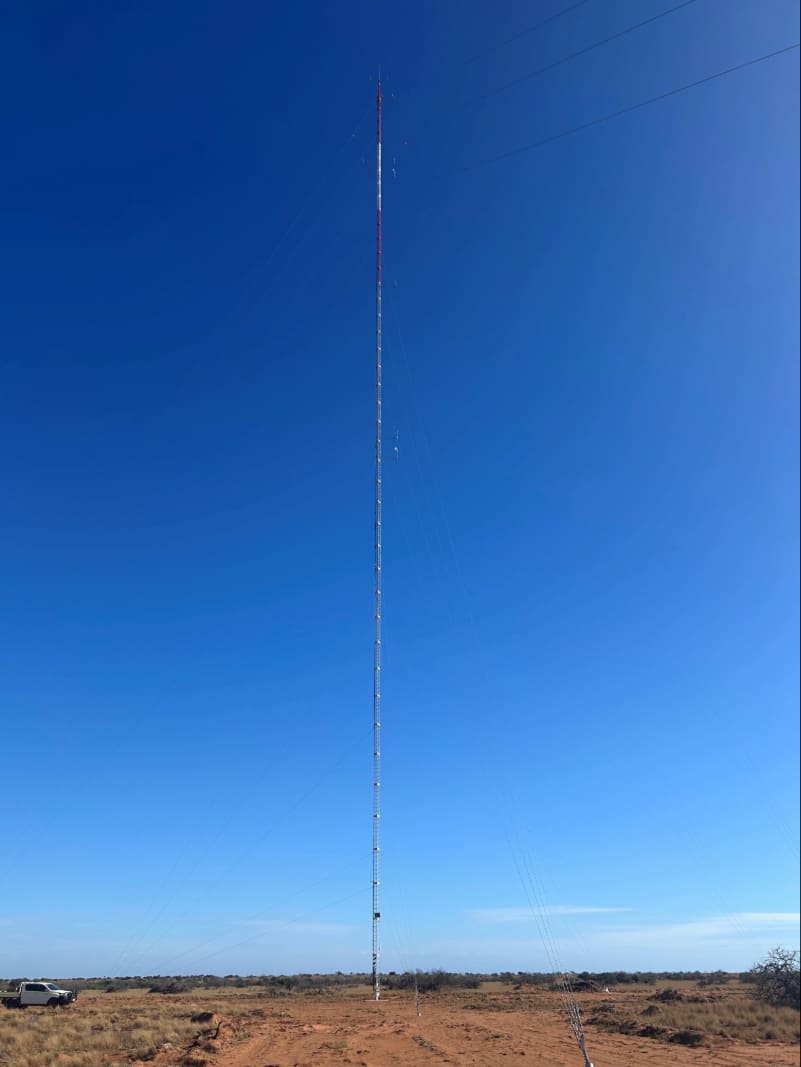
The proof has been measured, not assumed. The resource has been independently characterised by wind consultants Wind Pioneers across 61,368 hourly observations, verified on site by roughly 2.8 years of SODAR monitoring and a meteorological mast installed in October 2025, and confirmed through full hour-by-hour dispatch modelling. The plant’s performance is a modelled output of that real record.
Explore the full resource record.
Resources mean little without the land to build on. Boolathana has both.
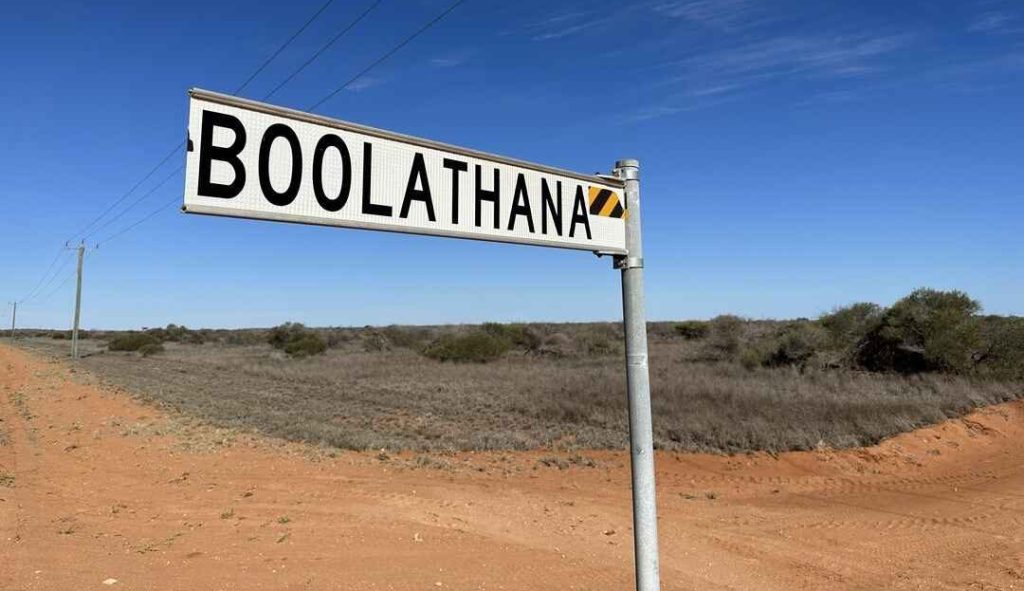
Gateway to the Gascoyne
One Title - One Owner - 15+GW
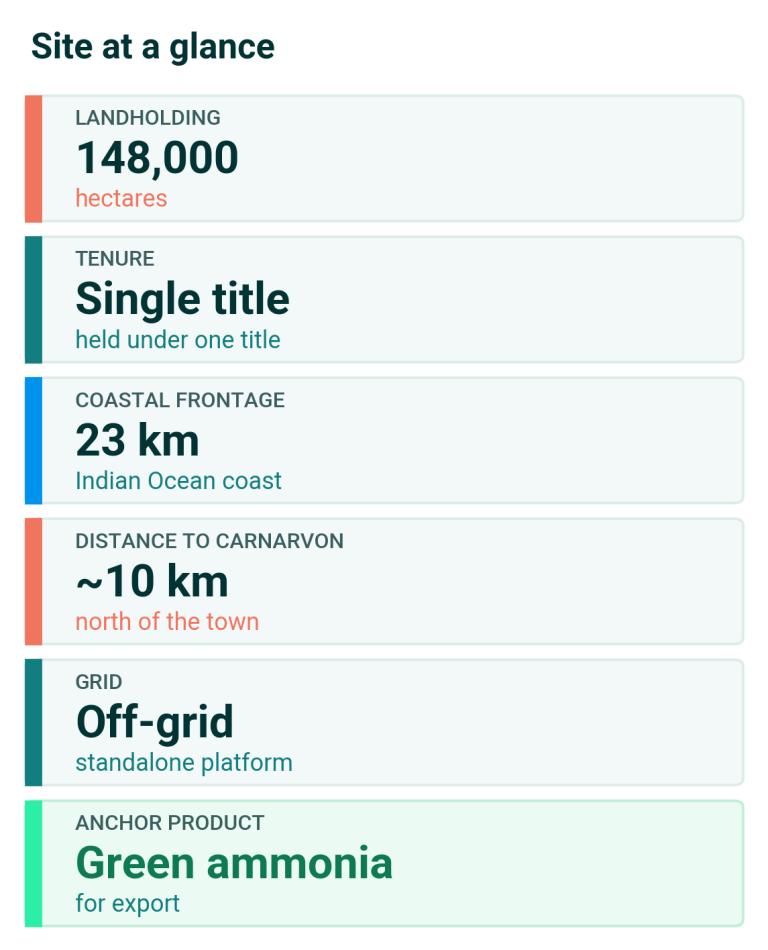
Gascoyne Green Energy is building an off-grid green energy platform on Boolathana – a 148,000-hectare pastoral lease – more than twice the size of Singapore. The property sits about 10 kilometres north of Carnarvon at its southern boundary, with 23 kilometres of Indian Ocean coast along its western edge.
Gascoyne Green Energy (GGE) holds exclusive rights to develop a top-tier renewable energy platform across the whole landholding, granted by the lessee, which is under common ownership with GGE.
That means a single point of contact for the entire platform, rather than a patchwork of interests to assemble – an advantage few projects of this scale can claim.
Elite renewable resources, coastal access and secure tenure rarely occur on a single site. Here they do, allowing co-location of energy generation, water, storage and export infrastructure that is scaleable.
Boolathana is the gateway to the Gascoyne, and to the green energy resource the region holds.


Firm before storage
A green ammonia plant has almost no fuel cost. Its energy is renewable and effectively unlimited, where conventional ammonia depends on a fossil feedstock it must keep buying. What sets its economics is how hard the plant runs: the share of the year it operates at full load, its capacity factor. The more hours it runs, the further the same investment is spread across the tonnes it makes.
But running at full load means running continuously, and renewables, left alone, don’t deliver continuous power. The sun sets; the wind rises and falls. Supplying an ammonia plant with steady, uninterrupted energy is called firmness, and it is the central problem of green ammonia.
Firmness usually has to be built in — oversized batteries, heavy overbuild, or distance from market. At Boolathana, the resource delivers it. Because generation is already near-continuous, the electrolysers can be sized to the plant’s steady draw rather than a multiple of it, and storage need only smooth hours, not bridge whole nights. That is redundant capital other projects carry and this site largely doesn’t — a structural advantage that sits with the resource, not with anything engineered on top of it.
Across the record, dispatchable firing is called on for only 11.4 per cent of the energy delivered, and it is green ammonia made on site, not fossil fuel.
The detailed cost modelling behind this is available to qualified investors under NDA
Why Ammonia?
Ammonia is one of the most important chemicals on earth. Around 180 to 200 million tonnes are made every year, and most of it feeds agriculture, sustaining a large share of the world’s food supply. It is a foundation of the present.
That foundation is built on fossil gas. Ammonia production is among the most carbon-intensive processes in heavy industry, responsible for close to two per cent of global CO₂ emissions. Decarbonising it is not optional, and it does not depend on any wider energy transition arriving first. The demand to clean up ammonia exists today.
Green ammonia meets that demand directly. Made from water, air and renewable electricity instead of gas, it is the same molecule, serving the same customers through the same infrastructure, without the emissions. This is GGE’s first market: not a new industry to be created, but an essential one to be supplied cleanly.
The uses beyond fertiliser, as a carbon-free shipping fuel, in power generation, across heavy industry, are real and growing. They are the next step. The starting point is the industry that already exists.
More Than One Product
The resource that makes green ammonia can do more. The same firm 24/7 power can support further businesses on the same platform.
Boolathana’s green ammonia can go to export markets or into Australia’s own nitrogen supply, and the same firm power can run industries that need clean electricity in every hour of the year. Green ammonia is the anchor, not the limit. The same firm power, water and shared infrastructure can, over time, support further industries on the one title — green cement, sustainable aviation fuel, and salt and magnesium from desalination brine among them.
Data Centres
Firm renewable power for the data centres behind AI, cloud and computing. Boolathana can deliver power that is carbon free in every hour of the year, generated and firmed on site, with no grid behind the meter and no fossil fuel in the system.
Integrated Platform
Green ammonia is the anchor, not the limit. The same firm power, water and shared infrastructure can, over time, support further industries on the one title — green cement, sustainable aviation fuel, and salt and magnesium from desalination brine among them.
Sovereign supply
The nitrogen Australia doesn’t make. Urea, ammonium nitrate and AdBlue underpin farming, mining and heavy transport, and almost all of it is made from gas or shipped in. Boolathana can produce the same molecule from water, air and renewable electricity, onshore.
Proven not proposed
Boolathana’s renewable resources are independently validated. The Pre-Feasibility Study is complete. A structured screen of potential environmental impacts identified no fatal constraints to the project proceeding, and the environmental studies now underway continue to build on that position.
GGE is raising development capital now – to carry Boolathana to a Final Investment Decision, not to build it. Construction is financed after that decision, against what this stage produces: independent technical certification, front-end engineering design, the second year of environmental studies, tenure conversion, and first offtake terms.
Boolathana is a project of the kind Western Australia’s project-facilitation frameworks exist to support, including the established Lead Agency Framework and the strengthened Priority Projects regime introduced in 2026.